
Review · ROME
Vespa Sidecar Tour: Rome by Night
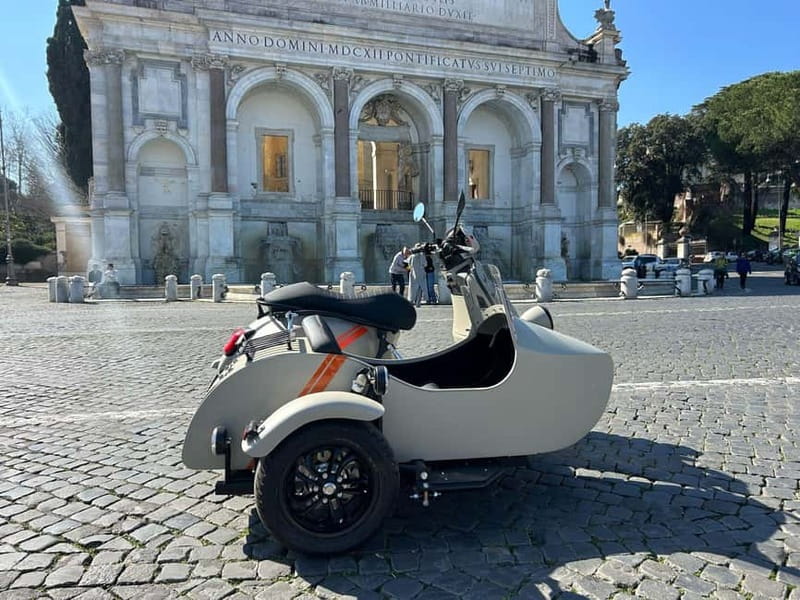
Rome after dark has a different rhythm. The Vespa sidecar gives you a lively way to see Rome’s major sights without asking you to handle its famously busy traffic. An English-speaking driver takes care of the road while you look around, listen, and stop for photos.
I especially like the small private format and the chance to see both grand monuments and local neighborhoods in one evening. Hotel pickup, if selected, is another useful touch. The main drawback is simple: this is a sightseeing ride, not an in-depth monument tour, and the short stops will not satisfy anyone hoping to enter the Colosseum, Pantheon, or Vatican museums.
The experience costs $131.04 per person for about three hours. That is a fair price if you value ease, atmosphere, and a broad route, but less attractive if you want long guided visits or included admission tickets.
Key points to know before booking
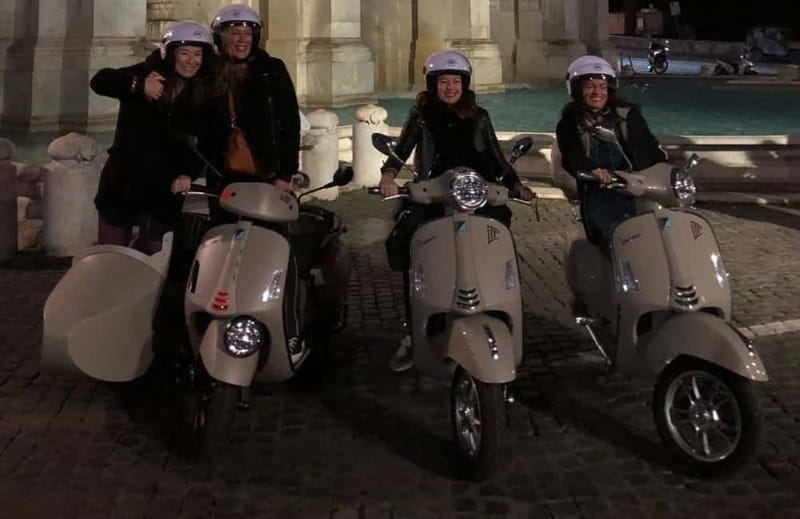
- Rome by sidecar: You ride through the city with a driver handling traffic and navigation.
- A wide evening route: The tour links Piazza del Popolo, Trevi Fountain, the Pantheon, Piazza Navona, the Colosseum, the Jewish Ghetto, Gianicolo, St. Peter’s Square, and Trastevere.
- Photo stops, not museum visits: The listed stop times range from five to fifteen minutes, and monument admission is not included.
- Private group setting: Only your group participates, with the group described as no larger than nine people.
- Optional hotel pickup: If selected, you wait outside your accommodation at street level for the driver.
- A guide-led ride in English: Certified helmets are included, and audio guides may be available on request.
Why a Vespa sidecar works well in Rome
Rome is spread across a large area, with major sights separated by hills, busy roads, and winding historic streets. Walking between all of these places in one evening would be tiring. Public transport can help, but it does not give you the same moving view of the city.
The sidecar solves that problem in a memorable way. You can cover a lot of ground while seated, with your driver managing the traffic. That matters most after dark, when Rome’s monuments are lit and the city takes on a more dramatic look.
I also like the balance between riding and stopping. You are not trapped in a vehicle for three hours without a break. The route includes several short pauses for photographs and orientation. Still, you should expect a panoramic introduction rather than a slow cultural lesson at each site.
The tour is offered in English, and an English-speaking driver-guide accompanies the ride. Audio guides may be provided if available and requested, but you should not treat that as guaranteed. The driver-guide is the main source of commentary.
More Vespa Sidecar Tours in Rome:
- Vespa Sidecar Tour By Night with Pickup
★ 5.0 · 1,803 reviews - Rome Morning Vespa Sidecar Tour in Rome with Cappuccino
★ 5.0 · 1,771 reviews - Rome: Highlights Vespa Sidecar Tour with Coffee and Gelato
★ 4.9 · 747 reviews
Piazza del Popolo begins the evening
The listed meeting point is Piazza del Popolo, at number 11. This is a useful place to begin because the square is easy to recognize and already gives you a taste of Rome’s grand urban design.
Piazza del Popolo once served as the main northern entrance to the city. At its center is an Egyptian obelisk that is about 3,000 years old and was brought to Rome under Emperor Augustus. The twin churches of Santa Maria in Montesanto and Santa Maria dei Miracoli frame the square with near symmetry.
Look uphill toward the Pincian Hill. The height gives you a broad view across Rome and makes this one of the better opening points for an evening ride. If you arrive early, take a few minutes to look around before the scheduled departure.
The meeting point is also the ending point. If you choose hotel pickup, the driver will come to the main entrance of your accommodation at street level. You should be ready a few minutes early and remain there during the stated pickup window, which can extend to ten minutes.
Trevi Fountain and the short-stop rhythm
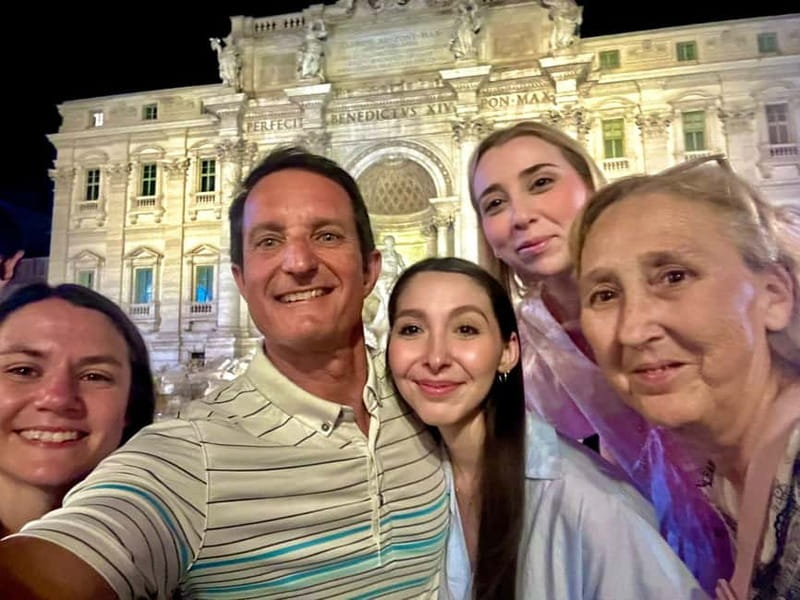
Trevi Fountain is scheduled for a ten-minute stop. That is enough for a quick look, photographs, and the traditional coin toss, but not enough for a long period of quiet observation if the square is busy.
The fountain is an 18th-century Baroque work by Nicola Salvi. Oceanus appears at the center, riding a shell-shaped chariot pulled by sea horses. The famous custom calls for tossing a coin with your right hand over your left shoulder to ensure a return to Rome. Money collected from the fountain supports charities in the city.
The best way to approach this stop is to see it as one part of a larger evening, not the entire event. You will not have to work out transport or directions after leaving, and you can enjoy the fountain without spending half the night getting there.
There is no admission charge for the stop. As with the other landmarks, the tour does not include entry to any attraction, though the fountain itself is viewed from the public square.
The Pantheon, Piazza Navona, and Baroque Rome
The route then brings you to the Pantheon and Piazza Navona, two places that show how ancient Rome and later Rome overlap.
The Pantheon began as a temple dedicated to all gods and was later converted into a church. Its huge dome remains its defining feature. The central oculus opens directly to the sky, allowing daylight and weather into the interior.
The tour information identifies the Pantheon as a sightseeing stop, but it does not list an entry period. Do not assume you will go inside. If seeing the dome from within matters to you, you will need a separate visit.
Piazza Navona receives a five-minute stop. That is brief, but the square is well suited to a quick look because its long shape, fountains, Baroque buildings, and cafés can be understood at a glance.
The square occupies the site of the ancient Stadium of Domitian. Its best-known work is Gian Lorenzo Bernini’s Fountain of the Four Rivers, representing the major rivers known in the 17th century. The short pause gives you time for a photograph and a quick orientation, but not much more.
This is one of the tour’s compromises. You get a broad sample of Rome’s design and history, yet each location receives only a small slice of the evening.
More Vespa Night Tours in Rome:
- Rome: Evening Vespa Sidecar City Tour
★ 4.9 · 104 reviews - Rome by Night Vespa Tour With Driver/Private Guide
★ 4.9 · 72 reviews - Vespa Scooter Night Tour in Rome with Professional Photographer
★ 5.0 · 46 reviews - Rome: Evening Fiat 500 and Vespa Prosecco Tour
★ 5.0 · 34 reviews
Piazza Venezia and the Colosseum after sunset
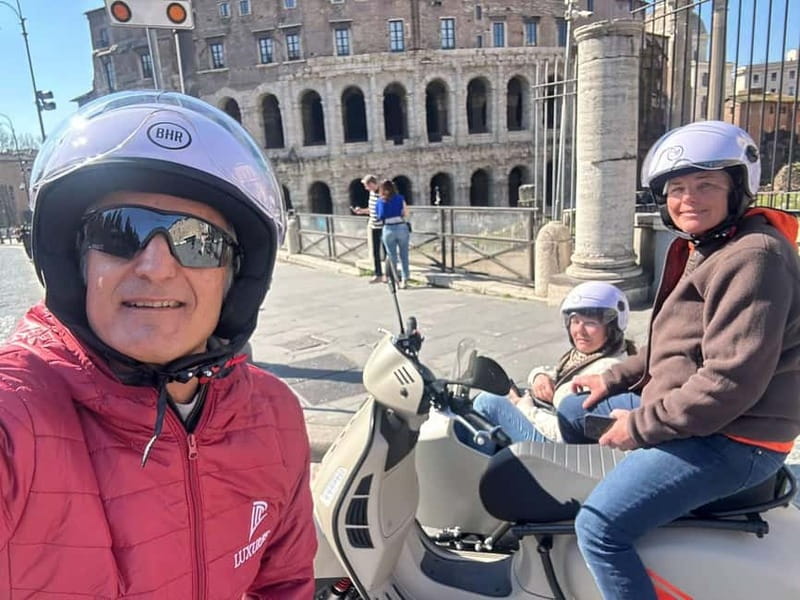
Piazza Venezia is one of the city’s busiest road junctions, so having a professional driver manage the approach is particularly useful. The square is dominated by the large Vittorio Emanuele II Monument, also called the Altar of the Fatherland.
The area also includes Palazzo Venezia, once used by popes and later associated with Mussolini during World War II. It is a place where modern traffic, national history, and ancient Rome meet within a small area.
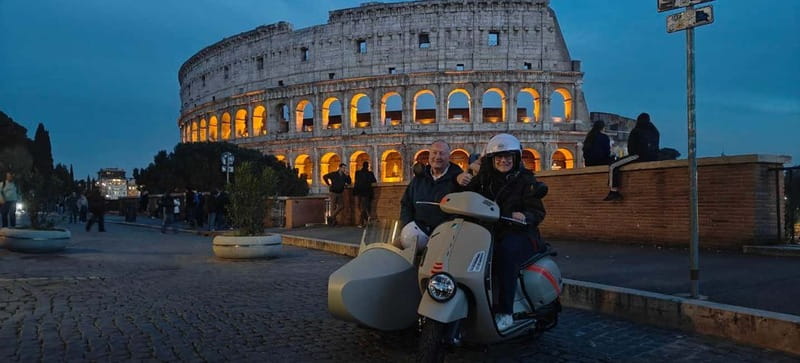
The Colosseum receives a ten-minute photo stop. Even with limited time, this is one of the strongest moments of the ride. The amphitheater was built in the first century AD and could hold more than 50,000 spectators. Gladiator contests, animal hunts, and public shows took place there.
The building has suffered from earthquakes, stone removal, and centuries of damage, yet its scale remains easy to grasp. At night, its illuminated arches can be especially striking.
You will not enter the Colosseum on this tour, and admission tickets are not included. That distinction matters. If you want the underground levels, arena floor, or upper viewing areas, plan a separate daytime visit with the required ticket.
Fifteen minutes in Rome’s Jewish Ghetto
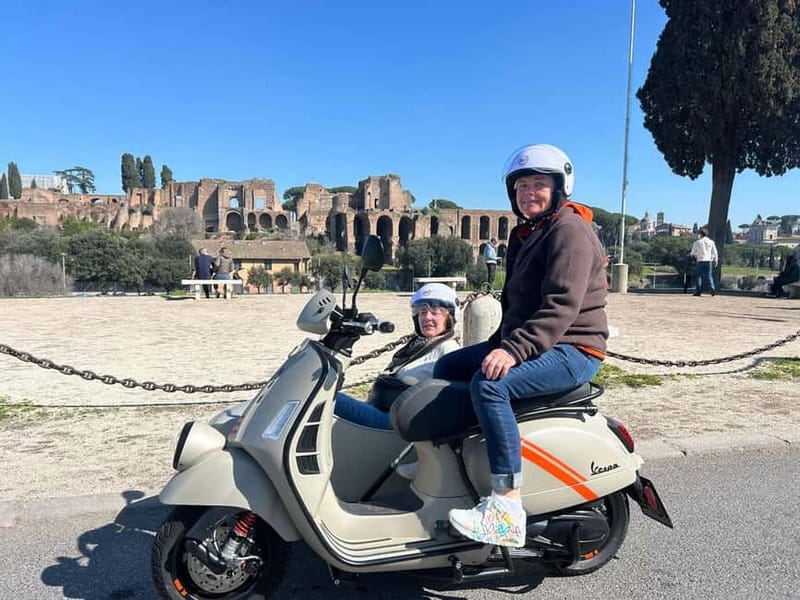
The Jewish Ghetto receives the longest listed stop, at fifteen minutes. That extra time is welcome because this neighborhood rewards a slower look than a single monument does.
The area includes ancient Roman remains, traditional shops, and the impressive synagogue. It also reflects the long presence of Rome’s Jewish community. The tour gives you a brief chance to take in the streets and local character rather than only photographing a famous landmark.
Still, fifteen minutes is not enough for a full neighborhood visit. If this part of Rome interests you, consider returning on foot. The sidecar tour works well as an introduction, helping you decide where you may want to spend more time later.
The Gianicolo viewpoint
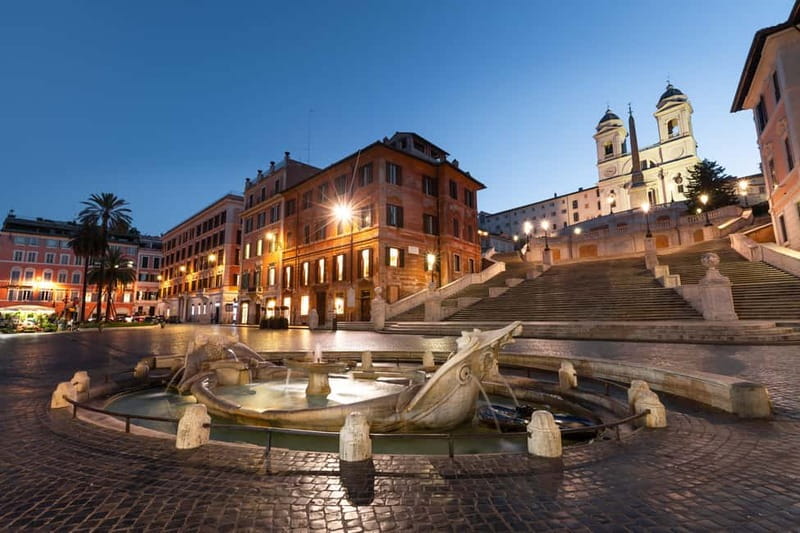
Colle del Gianicolo, or Gianicolo Hill, is one of the highest points in Rome and one of the route’s best places for a city view. From here, the focus shifts from individual monuments to the wider shape of Rome.
The hill is linked with Giuseppe Garibaldi and the battles of Italian unification. It also carries on a daily cannon tradition that began in 1847 under Pope Pius IX, when the cannon helped standardize the city’s clocks.
The listed stop lasts ten minutes. That should give you time to look out across Rome and take photographs, though the exact view can depend on conditions and light. This is a particularly good reason to choose the evening tour: the city below becomes part of the experience rather than just a route between monuments.
St. Peter’s Square and Vatican City
St. Peter’s Square receives another ten-minute stop. The square was designed by Bernini as an open, welcoming space for pilgrims. Its sweeping colonnades form a semicircle, often read as the Church’s arms reaching around the square.
An ancient Egyptian obelisk occupies the center, with fountains on either side. The square leads directly to St. Peter’s Basilica, whose dome was designed by Michelangelo and which is described as the world’s largest church.
Again, this is an outside viewing stop. The tour does not include entrance tickets to St. Peter’s Basilica or other monuments. Ten minutes is enough to see the layout and take in the scale, but not enough to explore the church interior.
If the basilica is a major reason for your Rome visit, treat this ride as a preview. You will need a separate visit for the interior, art, and dome.
Trastevere closes the loop
The final neighborhood stop is Trastevere, one of Rome’s most recognizable areas for cobbled lanes, picturesque alleys, lively squares, and local atmosphere. The ten-minute pause gives you a taste of the neighborhood’s texture.
This is a fitting end to the route because it shifts the focus away from emperors, popes, and national monuments. You see a more everyday side of Rome, though the short stop means you will not have time for a full meal or extended wandering.
Food and drinks are not included. If you want dinner in Trastevere, plan it before or after the ride rather than expecting the tour to provide a break for eating.
What the $131.04 price really buys
At $131.04 per person, this is not a low-cost way to check off Rome’s sights. You are paying for a private ride, an English-speaking driver-guide, transport between widely separated areas, certified helmets, and a route that would take much longer to organize independently.
The value is strongest for people who want convenience and atmosphere. You can see the Colosseum, Trevi Fountain, St. Peter’s Square, the Jewish Ghetto, and Trastevere in one evening without arranging several taxis or studying complicated routes.
The value is weaker if you judge the tour by monument access. Entrance tickets are excluded, and the stops are short. You will pay for mobility and guided sightseeing, not for extended time inside the attractions.
The private format also matters. Only your group participates, and the experience is described as having no more than nine people. That gives the outing a more personal feel than a large coach tour, although a full group of nine will feel different from a ride with only two or three people.
Practical details that shape the experience
The ride lasts about three hours and is offered in English. Certified helmets are included. Gratuities, food, drinks, and entrance tickets are extra.
Pickup is available if selected. You should wait outside the main entrance of your hotel or accommodation, at street level. The driver arrives at the scheduled time or within a ten-minute window, so do not wander away while waiting.
Most people can participate, and the meeting point is near public transportation. Confirmation is provided at booking. Free cancellation is available if you cancel at least 24 hours before the local start time. Cancellations or changes within 24 hours are not refunded or accepted.
The strongest praise attached to this experience centers on the guide team. Massimo, Fabritzio, Daniele, and Atakanda are specifically credited with making a family outing feel special. That personal attention is worth keeping in mind when comparing this ride with a standard sightseeing bus.
Who should book this sidecar tour?
I would recommend it to first-time Rome visitors who want a fast overview, couples looking for an unusual evening ride, and families who prefer sitting back while someone else handles city traffic. It also suits anyone with limited time who wants to see Rome’s major sights from the outside.
You should think twice if your priority is archaeology, church interiors, or long explanations at each site. The route is wide rather than deep. You will see many important places, but the tour leaves the detailed exploration to you.
It is also a good fit if you want a private experience and appreciate the flexibility of hotel pickup. The combination of a driver-guide, short photo stops, and evening views gives you a lively introduction without the effort of planning every transfer.
Should you book it?
Book this tour if you want Rome’s greatest hits in one manageable evening, with a guide handling the roads and a sidecar adding a little fun. The best parts are the range of the route, the private setting, the Gianicolo view, and the personal guide service praised by name.
Skip it if you want included monument entry or hours inside the Colosseum, Pantheon, or St. Peter’s Basilica. For most people, the smartest plan is to use this ride as an orientation, then return to your top two or three sites for proper visits.
FAQ
How long does the Vespa sidecar tour last?
The tour lasts approximately three hours.
Where does the tour begin?
It begins at Piazza del Popolo, 11, 00187 Rome, Italy.
Where does the tour end?
The activity ends back at the meeting point.
Is hotel pickup available?
Yes. Hotel pickup and drop-off are available if selected when booking.
What should I do for hotel pickup?
Wait outside the main entrance of your hotel or accommodation at street level. Be ready a few minutes early and remain there during the possible ten-minute waiting window.
Is the tour private?
Yes. Only your group participates. The group is described as no larger than nine people.
Is the tour offered in English?
Yes. An English-speaking driver-guide leads the experience.
Are attraction entrance tickets included?
No. Entrance tickets to monuments and attractions are not included.
Can I cancel for a full refund?
Yes, if you cancel at least 24 hours before the experience start time. Cancellations or changes made within 24 hours are not refunded or accepted.
Just added around Rome
- Vespa Tour – Explore Ancient Rome★ 5.0 · 5 reviews
- Vespa Sidecar Tour : Rome by Night★ 4.1 · 7 reviews
- Food tour & Vespa tour & Photo tour! All included★ 5.0 · 2 reviews
- Vespa Sidecar Tour: Highlights of Rome★ 4.7 · 10 reviews
- Rome: Vespa Tour with Gelato and Photos★ 4.9 · 7 reviews
- Vespa Tour with Professional Photographer★ 4.9 · 9 reviews
- Rome by night on Vespa★ 4.9 · 11 reviews
- Vespa Scooter Tour “Rome as a Local”★ 5.0 · 12 reviews
Vespa Sidecar Tours, compared.

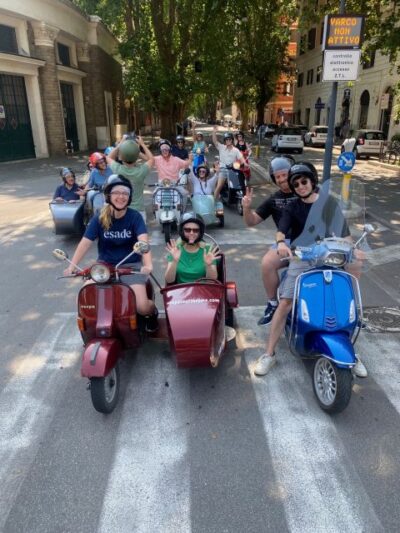
Rome Morning Vespa Sidecar Tour in Rome with Cappuccino
Read our review →Highlights Vespa Sidecar Tour with Coffee and Gelato
Read our review →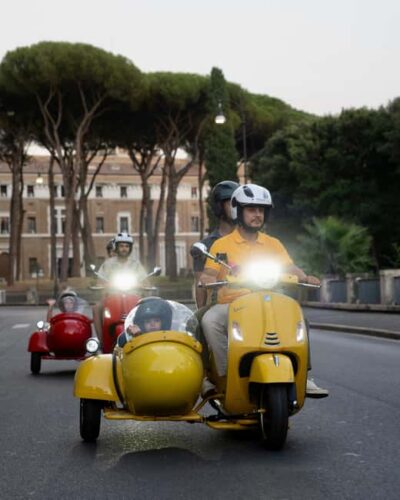
Rome Afternoon Sightseeing Vespa Sidecar Tour with Gourmet Gelato
Read our review →Vespa Sidecar Tour In Rome with Pickup, Drop-off, Gelato included
Read our review →Rome Vespa Sidecar Tour: 90-Minute Panoramic Experience
Read our review →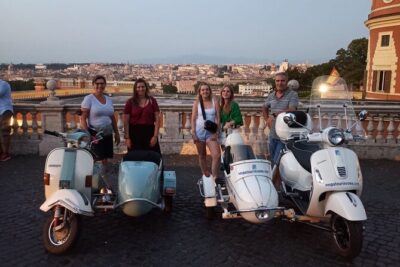
Browse the lists this ride appears in